Devising visible strategies to address hidden problems
A seminar organised by the Institute for Local Governance at MEA House, Newcastle,Friday 7th December 2018, 9.30 – 13.00
THIS SEMINAR IS NOW FULLY BOOKED
In October 2018, the Government launched A Connected Society: a strategy for tackling loneliness. It is a wide-ranging document which recognises that loneliness can affect people in all stages of the life course and is often compounded by social isolation.
The seminar aims to explore the underlying meanings and causes of loneliness and isolation so that informed debate can ensue on what can be done about it for different constituencies of people. We can’t cover everything, so in this seminar we will look at either end of the life-course, focusing on the experience of young people and older people – to see what experiences they may have in common and those which differ.
Tackling loneliness, as the seminar will show, is not an easy thing to do. Often feelings of loneliness and isolation are associated with social stigma – this can potentially undermine well-meaning attempts to tackle the problem through, for example, generalised approaches to social prescribing. This was recognised in the Jo Cox Commission on Loneliness report ‘Combating loneliness one conversation at a time.’ Simplistic strategies which look for easy answers will not work.
So the seminar looks at a variety of approaches which have been taken in North East England to consider their merits, but also learn from the difficulties they encountered in reaching and supporting people with diverse experiences and needs.
The seminar will be chaired by Cullagh Warnock, Trust Manager, Millfield House Foundation, and speakers will include:
- Professor Thomas Scharf, Professor of Social Gerontology, Institute of Heath and Society, Newcastle University: on understanding the similarities and differences between loneliness and isolation.
- Lesley Carberry-Campbell, Head of Regions, England and the Channel Islands, Silverline: on the provision of out-of-hours and weekend support for lonely or isolated older people.
- Dr Stephen Crossley, Senior Lecturer in Social Policy, Department of Social Work, Education and Community Wellbeing, Northumbria University: on a multi-agency intervention to tackle loneliness and isolation in Gateshead.
- Helen Mills, Chief Executive Officer, Age UK Northumberland: on the priorities to be tackled when addressing loneliness and isolation amongst older people.
- Steve Watson, Development Advisor, Youth Focus North East: on raising awareness of isolation and loneliness amongst young people.
The seminar is free to attend, but places are limited and they tend to book up quickly, so please register your attendance via: Janet Atkinson, Institute for Local Governance, Durham University janet.atkinson@durham.ac.uk.
The Institute for Local Governance is a North East Research and Knowledge Exchange Partnership established in 2009 comprising the North East region’s Universities, Local Authorities, Police and Fire and Rescue Services.
Seminar presentations can be downloaded as pdf documents below:
Steve Watson – Loneliness and Isolation 7th December 2018
Tom Scharf – Loneliness and Isolation
Silverlline – Loneliness and Isolation Seminar
Helen Mills – Loneliness and Isolation
 In this hard-hitting paper, Tim Blackman, a serving Vice-Chancellor, calls for a much less hierarchical higher education sector. He shows how this will benefit students, the quality of learning and social mobility and, most importantly, he shows how to get there.
 As Policy&Practice gear up for the fifth wave of the Third Sector Trends study in 2019 across North East England, it is crucial to understand the link between the wellbeing of the charity sector and philanthropic giving.
 ntly published article in Discover Society, Professor Tony Chapman, Director of Policy&Practice, and Honorary Professor of Social Policy in the Department of Sociology summarises the pitfalls of focusing too much on individuals’ responsibility to commit to long-range social mobility at the expense of more proximate and realistic ambitions.
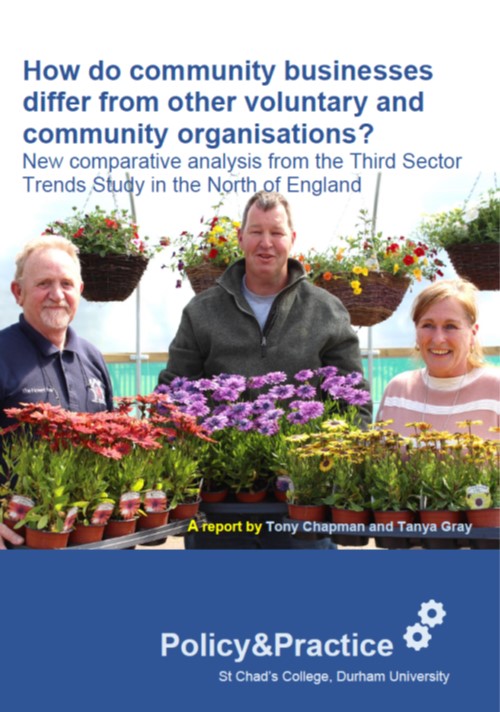 It is generally accepted that community businesses are distinctive because they are locally rooted, they trade for the benefit of the local community and, as such, they are capable of achieving community impact. While community businesses may be located in communities and contribute to them socially and economically, to what extent are they accountable to communities; and if so, how might that be assessed? Furthermore, the seminar asks: does community accountability matter if they are providing jobs, facilities and services?
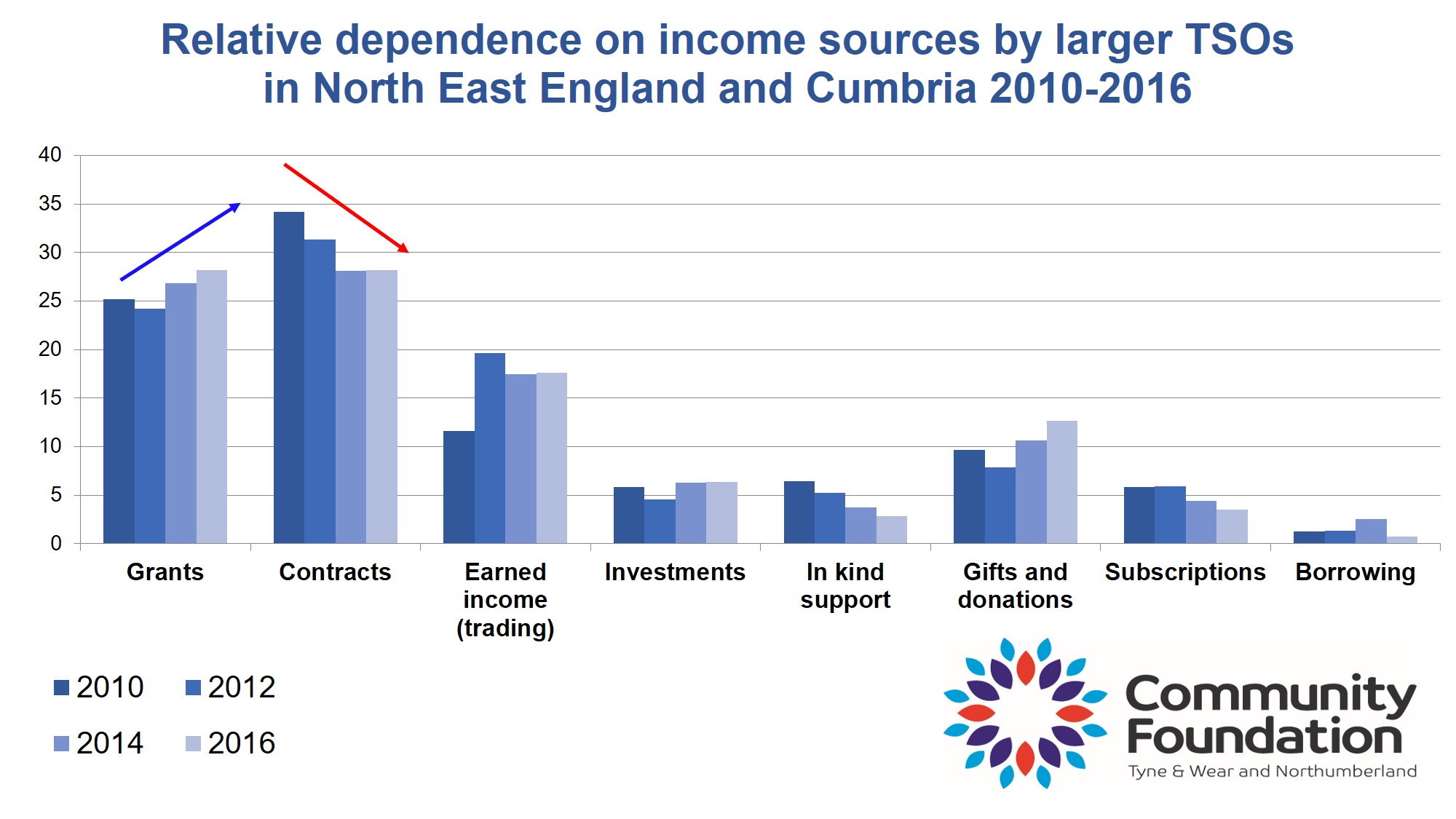
 & Wear and Northumberland has been running every two years since 2010. The survey of over 1,000 Third Sector organisations (TSOs), asks charity bosses to assess the value of different sources of funding in ‘relative’ terms – that is to tell us about the balance of reliance on different sources of income.