
 In January 2018, Professor Kanji Tanimoto from Waseda University, Tokyo, will come to Durham on a two week research visit to St Chad’s College as a Visiting Professorial Fellow. In addition to the delivery of a seminar on 18th January in St Chads, he will meet colleagues from Durham University Business School, Newcastle University Business School and Newcastle Business School (Northumbria University). Meetings have also been arranged with the Institute for Advanced Studies, Teikyo University and the North East Initiative on Business Ethics (NIBE).
Kanji Tanimoto is Professor in Business and Society at the School of Commerce, Waseda University, Japan. He recently was Visiting Professor at the Free University of Berlin, Cologne Business School and National Taipei University. Prior to joining Waseda, he was a professor at the Graduate School of Commerce, Hitotsubashi University. He received his doctorate in business administration from the Graduate School of Business Administration, Kobe University.
He is Founder and President of an academy: Japan Forum of Business and Society, which is the first academic society in this field in Japan. He is an editorial member of several journals. He serves on the program committee of the International Conference on Corporate Social Responsibility at Humboldt University. He has been consulting and providing advice to leading Japanese companies on CSR management over the last 20 years. He also has advised Japanese government committees on business & society and social business.
His research interests include the relationship between business and society, corporate social responsibility, social business and social innovation. He has published numerous books and papers.
His personal website is: http://tanimoto-office.jp and email address: k.tanimoto@tanimoto-office.jp
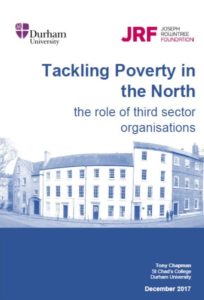 survey of 3,500 charities across the North East, North West and Yorkshire and Humber to capture their contribution in the region.

 Professor Fred Robinson has been working with Professor Keith Shaw and Sue Regan of Northumbria University on a major study of governance in the North East of England. The findings have just been published; the Report is now available at
 Weston Foundation, includes responses from 1,462 third sector organisations in the North West of England.
 wo other major studies in North East England, funded by Community Foundation Tyne & Wear and Northumberland (who are now responsible for the legacy of the Northern Rock Foundation Third Sector Trends study and for the development of future iterations of the project) and Yorkshire and the Humber funded by Joseph Rowntree Foundation.

 ents in Durham University Business School.
 This is the first time in the project that public-sector organisations involved in the project have come together with other funding organisations, infrastructure bodies and practicing third sector organisations.
 This report presents key findings from the Third Sector Trends study in 2016 from across Northern England and specifically in North East England and for each of its four sub-regions: Northumberland, Tyne and Wear, County Durham and Tees Valley. Key findings can be found in the